
Introduction
Managing a real estate business in Dubai involves more than finding buyers and showing properties. Agents and brokerage teams handle enquiries from property portals, websites, advertising campaigns, social media and direct referrals. Each conversation may involve a different property, budget, location and stage of the buying process.
Keeping track of these enquiries becomes difficult when information is spread across spreadsheets, phone records and messaging applications. An agent might remember a client’s property requirements but overlook a follow-up, while a brokerage manager may struggle to understand which enquiries have been assigned or how many opportunities are progressing towards a deal.
This is where CRM software for real estate agents becomes useful. A dedicated system brings client information, property enquiries, communication history and sales activities into one place. It also gives managers a clearer picture of how their teams handle incoming opportunities.
However, not every CRM is suitable for the way Dubai property businesses operate. Before choosing a platform, it is important to understand its features, integration capabilities, automation options and ability to support your agency as it grows.
1. Why Real Estate Agents in Dubai Need CRM Software
Dubai’s property market involves different types of transactions, including residential sales, commercial properties, rentals and off-plan developments. Agents may communicate with first-time buyers, international investors, landlords, tenants and property developers within the same working day.
Managing these relationships requires an organized process. A real estate CRM helps agencies maintain consistent records and coordinate activities across their teams.
Managing Multiple Property Enquiries and Client Relationships
Property enquiries can arrive through several channels. A buyer might contact an agency through Bayut, another prospect may submit a form on its website, and an investor may approach an agent through WhatsApp.
Without a centralized system, agents often have to switch between different applications to understand a client’s requirements and previous conversations.
A real estate CRM system creates a central record for each prospect. Depending on the platform, this record can include:
- Client name and contact information.
- Preferred property type and location.
- Purchase or rental budget.
- Lead source and enquiry date.
- Assigned agent and follow-up status.
- Previous calls, messages and appointments.
- Properties shared with the client.
This information gives agents useful context before they contact a prospect again.
Challenges of Managing Leads Through Spreadsheets
Spreadsheets can work for an individual agent handling a small number of contacts. Problems usually appear when the number of enquiries increases or multiple employees need access to the same information.
Common difficulties include duplicate records, inconsistent updates, missed reminders and limited visibility into team activities.
A spreadsheet also cannot independently distribute new enquiries to available agents or maintain an integrated communication history without additional tools.
CRM software addresses these limitations by organizing records and supporting repeatable workflows. Managers can review the progress of enquiries without asking every agent to prepare a separate update.
Improving Agent Productivity With Centralized CRM
Agents spend a considerable amount of time communicating with prospects, arranging property viewings and coordinating with colleagues.
A centralized CRM helps reduce unnecessary administrative work. Agents can review assigned enquiries, update lead statuses, schedule follow-ups and access relevant property information from one system.
The objective is not to replace the relationship-building part of real estate sales. It is to give agents more time to focus on clients rather than manually organizing records.
2. What Is Real Estate CRM Software and How Does It Work?
Real estate CRM software is a customer relationship management system designed to organize the interactions between property businesses and their customers.
Unlike a basic contact database, a dedicated real estate CRM can connect customer information with property requirements, listings, sales opportunities, communication activities and agent assignments.
A typical workflow begins when a prospect submits an enquiry. The CRM records the information, identifies the lead source and makes it available to the appropriate team member. The agent can then contact the prospect, discuss property requirements, arrange a viewing and update the opportunity as it progresses.
Cloud-based systems allow authorised team members to access business information across locations, while cloud application development provides a broader approach to building and maintaining online business applications.
How a Real Estate CRM System Organizes Customer Information
A well-organized CRM maintains customer information in structured records.
For example, an agent working with a buyer interested in a two-bedroom apartment in Dubai Marina should be able to review the client’s budget, preferred location, previous enquiries and communication history without searching through separate applications.
The same principle applies to landlords, tenants, sellers and investors.
By maintaining these records centrally, agencies can reduce information gaps when an enquiry moves between agents or departments.
How Property Leads Move Through the CRM Sales Pipeline
A sales pipeline provides a structured view of opportunities at different stages.
A brokerage might organize its pipeline using stages such as:
- New enquiry received.
- Lead assigned to an agent.
- Initial contact completed.
- Requirements confirmed.
- Property options shared.
- Viewing scheduled.
- Negotiation in progress.
- Deal closed or opportunity lost.
These stages help managers understand where opportunities are progressing and where additional attention may be required.
The stages should reflect the agency’s actual sales process rather than forcing every property transaction into a generic workflow.
Cloud-Based CRM and Mobile Accessibility
Real estate agents do not always work from an office. They may attend property viewings, meet clients, visit developer offices or communicate with prospects while travelling.
Cloud-based CRM software allows authorized users to access business information through supported devices and browsers.
A mobile application can make it easier to review enquiries, update lead statuses, record communication activities and manage follow-up tasks while away from the office.
When evaluating mobile access, check whether the application provides the functions your agents actually need rather than simply offering a mobile-friendly version of the website.
3. 12 Essential Features to Look for in CRM Software for Real Estate Agents
Choosing CRM software should begin with the daily requirements of your business. A platform may offer dozens of functions, but only some will have a direct impact on your team’s workflow.
The following features deserve particular attention when comparing real estate CRM systems in Dubai.
1. Automated Property Lead Capture
Lead capture is one of the most important functions of a real estate CRM.
Agencies receive enquiries from websites, property portals, Google Ads, social media and other marketing channels. Manually transferring each enquiry into a database creates unnecessary work and increases the possibility of missing information.
Automated lead capture connects supported sources with the CRM so incoming enquiries can be recorded centrally.
Before purchasing a platform, ask which sources it supports, whether the connection uses an API and how duplicate enquiries are handled.
2. Smart Lead Assignment and Distribution
A brokerage with several agents needs a clear process for distributing new enquiries.
Lead assignment functionality allows incoming prospects to be allocated according to business rules. These may include location, property type, language, agent availability or team responsibilities.
For example, an enquiry about an off-plan apartment in Business Bay may be directed to an agent responsible for that development category.
The manager should also be able to review assigned enquiries and identify records that have not received an appropriate response.
3. Lead Tracking and Follow-Up Management
An enquiry does not automatically become a sale. Some prospects are ready to arrange a viewing, while others need additional information before making a decision.
A CRM should allow agents to record conversations, update lead statuses and schedule follow-up activities.
Automated reminders can help agents remember when to contact a prospect again. This is particularly useful for agencies handling a large number of active enquiries.
4. Buyer and Seller Contact Management
Real estate businesses work with different customer groups, each with specific requirements.
A CRM should provide organized contact records for buyers, sellers, landlords, tenants, investors and property developers.
Agents should be able to distinguish between these groups and find relevant information without creating unnecessary duplicate records.
Useful contact information may include preferred locations, property requirements, budgets, communication preferences and previous interactions.
5. Property Listing and Inventory Management
A property CRM should make it easier to organize available listings.
Agents need access to information such as property type, location, price, availability, photographs and relevant project details.
Inventory management becomes particularly important for brokerages handling both off-plan and secondary-market properties.
A useful system should help agents identify suitable listings based on a client’s requirements rather than relying entirely on manual searches.
6. Bayut and Property Finder Integration
Property portals are important enquiry sources for many Dubai real estate agencies.
A CRM with supported Bayut and Property Finder integrations can help bring incoming enquiries into a centralized lead management process.
However, the term integration can describe different levels of functionality. Some connections may transfer enquiries, while others may support additional listing synchronization or status updates.
Ask the provider to demonstrate the actual integration, including how enquiries are received, assigned and recorded.
Also confirm which API permissions and account requirements apply.
7. Dubizzle Integration
Dubizzle is another property marketplace that agencies may use to promote available listings.
If your business receives enquiries through this platform, check whether the CRM supports the required connection.
The objective is to avoid maintaining separate lead records for every marketing channel.
A centralized process also makes it easier to identify which sources generate enquiries and which opportunities progress further through the sales pipeline.
8. WhatsApp Business Integration
WhatsApp is widely used for business communication in the UAE, including property enquiries, viewing arrangements and client updates.
A CRM with WhatsApp integration can help agents communicate with prospects while maintaining relevant interaction records.
Depending on the integration, available functions may include message templates, contact access, notifications and automated communication workflows.
For business messaging at scale, check whether the platform uses the official WhatsApp Business Platform and follows applicable consent and messaging requirements.
9. Email and SMS Communication
Not every client prefers WhatsApp. Some customers expect email correspondence, while others may receive appointment reminders through SMS.
A CRM that supports multiple communication channels helps agencies maintain a consistent approach.
Email and SMS workflows can be useful for appointment confirmations, property updates and follow-up reminders.
Before selecting a platform, check whether these features are included in the package or require additional services.
10. Sales Pipeline and Deal Tracking
Managers need to understand what is happening across their active opportunities.
Sales pipeline functionality provides an overview of prospects, negotiations, property viewings and completed transactions.
For example, a manager may want to review how many enquiries have reached the viewing stage or which agents are managing the most active negotiations.
This information supports better workload planning and more informed management decisions.
11. Agent Performance and Reporting
A CRM should provide more than a list of customer records. Reporting helps managers understand how their team is using the system.
Useful reporting areas include:
- New enquiries received.
- Leads assigned to each agent.
- Follow-up activity.
- Completed property viewings.
- Active opportunities.
- Closed deals.
- Lead sources and campaign performance.
Reports should be relevant to the agency’s management process. Too many unnecessary metrics can make it harder to identify the information that actually matters.
12. Mobile CRM Access
A mobile CRM application is particularly useful for agents who spend much of their working day outside the office.
Agents should be able to review customer information, access assigned enquiries, update sales activities and manage communication through supported mobile features.
Check whether the application is available for the devices used by your team and whether important functions remain accessible while agents are working remotely.
4. How Real Estate CRM Software Improves Lead Management
Lead management involves more than collecting contact information. It requires a consistent process for organizing enquiries, understanding customer requirements and maintaining communication until an opportunity reaches its next stage.
Real estate lead management software helps agencies establish this process.
Capturing Enquiries From Multiple Marketing Channels
A brokerage may advertise properties through several portals while also generating enquiries from its website, Google Ads and social media.
When these channels are connected to a CRM, incoming records can be collected in a central location.
This gives agents a more complete view of their enquiries and helps managers understand where potential customers are coming from.
Assigning Property Leads to the Right Agents
Lead distribution is important when a brokerage has agents specializing in different areas or property categories.
A CRM can use predefined assignment rules to direct enquiries to suitable team members.
For example, an agency may assign commercial property enquiries to one team and residential buyer enquiries to another.
The rules should be reviewed regularly to ensure they reflect agent availability and the agency’s current responsibilities.
Automating Lead Follow-Ups and Reminders
A prospect may not be ready to make a decision during the first conversation.
Follow-up workflows allow agents to schedule future communication based on the customer’s requirements and level of interest.
A CRM can also generate reminders for pending activities and, where supported, automate approved messages through connected channels.
Automation should support meaningful communication. Sending repeated messages without considering a client’s preferences can damage the relationship rather than improve it.
Tracking Prospects From First Contact to Deal Closure
A structured pipeline makes it easier to understand the progress of each opportunity.
Managers can review whether an enquiry has been contacted, whether the client has received suitable property options and whether a viewing has been arranged.
This visibility helps identify delays and gives management a clearer basis for deciding where additional support is needed.
5. Important CRM Integrations for Dubai Real Estate Agencies
Integration requirements deserve special attention when selecting CRM software for the UAE market.
A platform may have excellent contact management features but still require substantial additional work if it cannot connect with the tools your agency already uses.
Property portal tools can also support listing and lead management. For example, Property Finder’s tools for real estate professionals include listing management, lead tracking and performance insights
Bayut Integration for Property Enquiries
Agencies advertising through Bayut should confirm whether their CRM can receive enquiries from the portal.
A supported connection can help transfer prospect information into the agency’s lead management workflow.
During a demonstration, ask the provider to show how a new enquiry appears in the CRM and whether its source information is retained.
Property Finder Lead Integration
Property Finder is another important portal to consider when evaluating real estate CRM software.
The connection should be assessed according to the functions your team needs, including enquiry capture, agent assignment and lead tracking.
Do not assume that every CRM offering portal integration provides identical functionality.
Dubizzle Integration
For agencies receiving enquiries through Dubizzle, check the available connection and how the CRM handles incoming customer information.
The goal is to manage enquiries from different channels without maintaining several disconnected databases.
WhatsApp Business Integration
A practical WhatsApp integration should fit the agency’s communication process.
Check whether agents can access customer conversations, use approved message templates and maintain relevant communication records.
Also review the requirements for automated and bulk messaging, including applicable platform policies and customer consent.
API Integration With Existing Business Systems
Some real estate companies use additional tools for accounting, property websites, marketing and internal operations.
An API can allow different systems to exchange information when compatible connections are available.
Before committing to a CRM, discuss the required integrations with the provider. Ask about implementation responsibilities, technical limitations, maintenance and any additional charges.
6. Choosing CRM Software for Different Real Estate Businesses
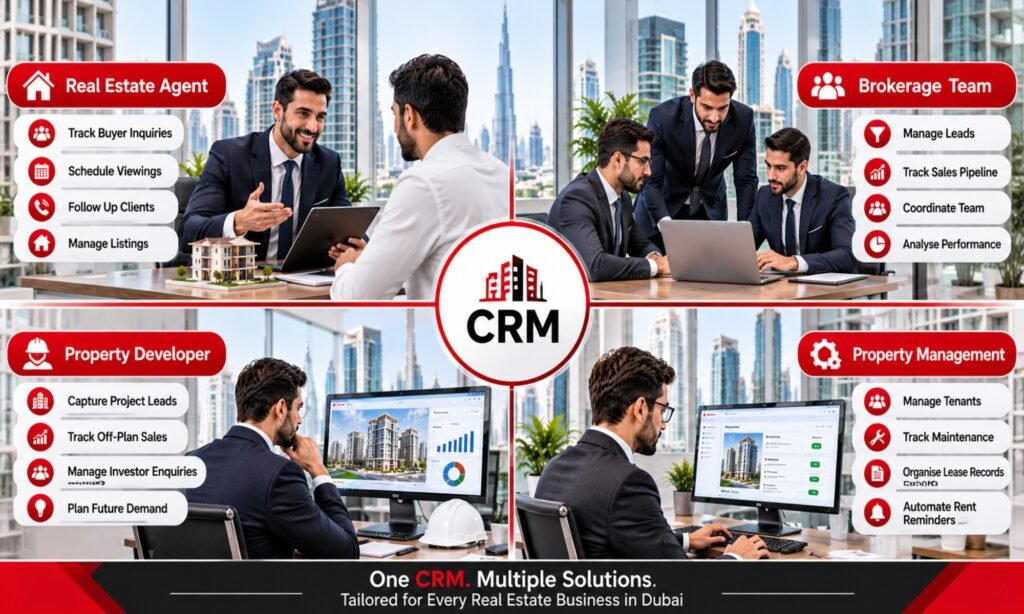
The right CRM configuration depends on the type and size of the property business.
An independent agent may need a straightforward way to manage contacts and follow-ups. A large brokerage may require more advanced lead distribution, reporting and access controls.
CRM Software for Independent Real Estate Agents
Independent agents generally need a system that is easy to operate and accessible from mobile devices.
Important requirements include contact management, property enquiries, follow-up reminders, communication history and listing access.
The platform should reduce administrative work without introducing unnecessary complexity.
CRM for Real Estate Brokerage Companies
Brokerage businesses need to coordinate multiple agents and maintain visibility across their sales operations.
Lead distribution, role-based access, team reporting, call management and centralized property records can be important requirements.
Managers should also be able to review agent activities and understand how enquiries progress through the sales pipeline.
CRM for Property Developers
Developers may manage several projects, investor relationships and broker networks simultaneously.
Their CRM requirements can include project-level lead tracking, sales team coordination, payment schedules and developer-to-broker communication.
A platform designed for developer workflows should make it easier to organize enquiries across different projects and monitor sales activities.
CRM for Off-Plan Property Sales Teams
Off-plan property sales involve a different set of requirements from standard secondary-market transactions.
Teams may need to organize project enquiries, unit preferences, investor information, payment schedules and broker relationships.
A suitable CRM should provide clear records for each opportunity and help sales teams monitor progress throughout the transaction.
CRM for Property Management Companies
Property management companies often handle tenants, landlords, leases, renewals, rent collections and maintenance activities.
Some real estate CRM platforms include these operational functions, while others focus mainly on customer relationships and sales.
Businesses should confirm whether the system provides the property management capabilities they require or whether a separate platform is necessary.
7. Real Estate CRM vs Property Management Software
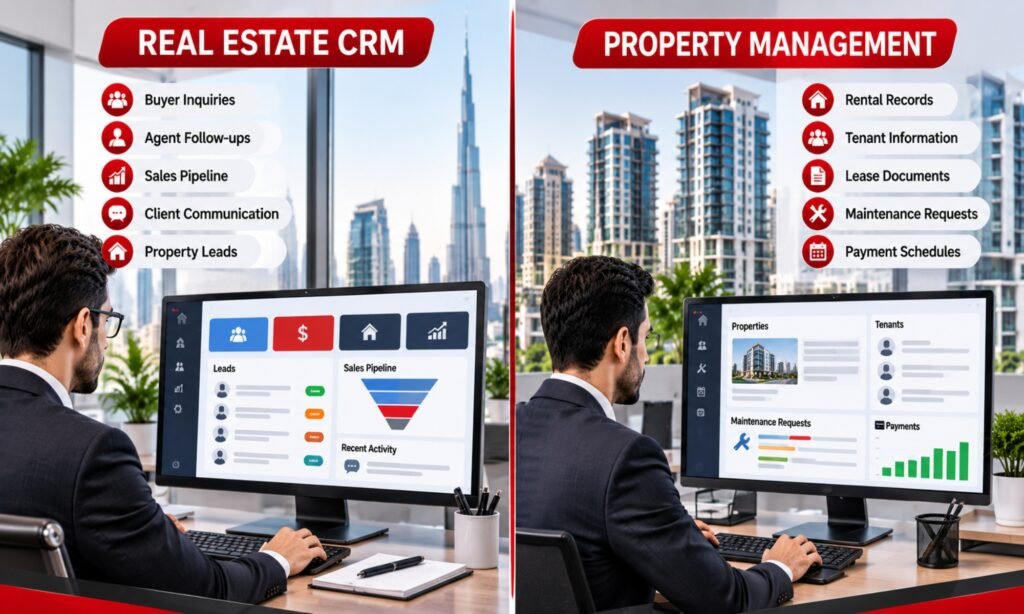
Real estate CRM and property management software are related, but they serve different operational purposes.
A CRM focuses primarily on customer relationships, enquiries, communication and sales opportunities. Property management software is generally concerned with the ongoing administration of properties and rental operations.
| Area | Real Estate CRM | Property Management Software |
| Customer enquiries | Core function | May be supported |
| Lead assignment | Common feature | Not always included |
| Sales pipeline | Core function | Usually limited |
| Property listings | Often included | Often included |
| Tenant records | May be supported | Core function |
| Lease management | Depends on platform | Core function |
| Rent tracking | Depends on platform | Common feature |
| Sales reporting | Core function | May be available |
| Maintenance requests | Depends on platform | Common feature |
When Does a Business Need Both Systems?
A brokerage focused mainly on property sales may prioritize lead management, communication and sales pipeline tracking.
A company managing rental properties may need more extensive tenant, lease and maintenance functionality.
Businesses handling both sales and property operations should evaluate whether an integrated platform can cover their requirements or whether separate systems would provide better functionality.
The decision should be based on operational needs rather than the number of features advertised by a software provider.
8. How to Compare CRM Software for Real Estate Agencies
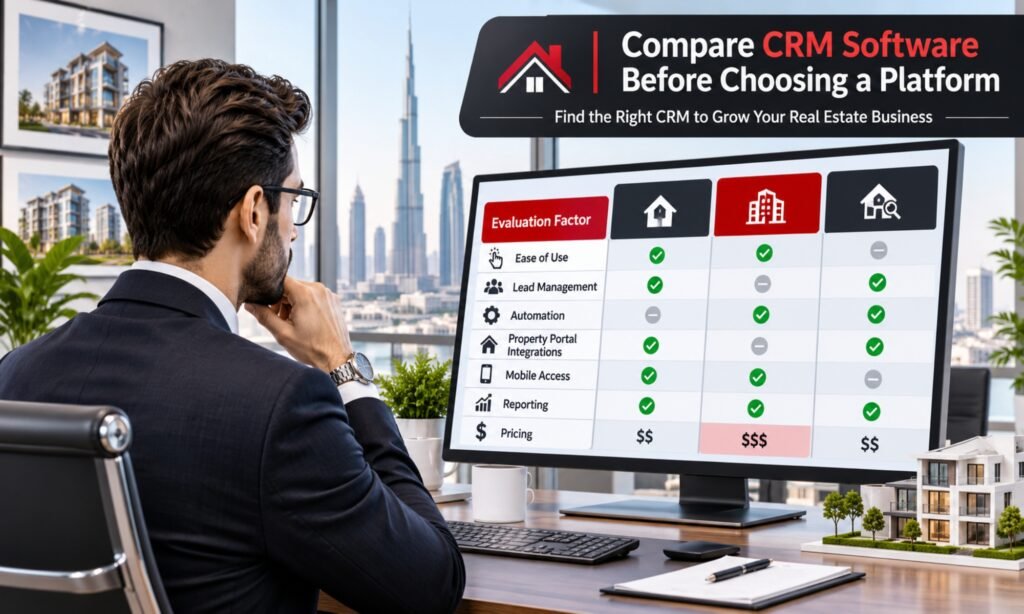
Once you understand your business requirements, compare providers using a consistent evaluation process.
Businesses evaluating different platforms can also review these CRM software options in Dubai and the UAE to understand the wider range of CRM solutions available.”
The cheapest CRM is not necessarily the most suitable, and the platform with the longest feature list may include functions your team will rarely use.
If standard CRM platforms cannot support specific business processes or integrations, agencies may explore custom software development services to assess whether a tailored solution is more suitable.
Customization and Integration Capabilities
Check whether the system supports your agency’s existing processes.
Ask whether lead assignment rules, sales pipeline stages, property categories and reporting dashboards can be configured.
Also review the integrations available for your property portals, website and communication channels.
User Access, Data Security and Cloud Hosting
Real estate businesses store customer details, contact histories and commercially important information.
Review the provider’s approach to access permissions, authentication, encryption, backups and data retention.
Ask who can view, edit and export customer information and what happens when an employee leaves the organization.
For UAE operations, also consider applicable data protection obligations and how the provider handles customer information.
Ease of Use and Agent Training
A CRM only becomes useful when employees use it consistently.
Ask for a live demonstration using workflows similar to your agency’s daily operations.
Check how easily agents can add contacts, review enquiries, update opportunities and schedule follow-ups.
A straightforward interface and appropriate onboarding can make adoption easier.
Customer Support and Implementation
Implementation involves more than creating user accounts.
The provider may need to configure workflows, connect integrations, organize existing records and train employees.
Before selecting a platform, ask about implementation timelines, migration support, training and ongoing technical assistance.
Pricing, Licensing and Scalability
Real estate CRM pricing can vary according to the number of users, features, integrations and support requirements.
Some providers offer monthly subscriptions, while others provide annual plans or one-time licensing arrangements.
Request a detailed quotation that explains:
- Initial setup and implementation costs.
- User licensing and subscription fees.
- Portal and communication integration charges.
- Additional customization costs.
- Training and support arrangements.
- Hosting and maintenance charges.
Also consider whether the pricing model remains practical as your agency adds employees, projects or new business operations.
9. A-One Real Estate CRM for Dubai Property Businesses
Choosing a CRM becomes easier when the platform reflects the way your business actually operates.
A-One Real Estate CRM is presented as a platform developed for property professionals in Dubai and across the UAE. Its service offering focuses on lead management, property listings, client communication, sales tracking and brokerage operations.
The company states that it has been serving the real estate sector since 2015.
For agencies evaluating a dedicated real estate CRM, the following capabilities are worth exploring during a product demonstration.
Centralized Lead and Client Management
A-One’s CRM page describes automated lead capture from supported sources, including Bayut, Property Finder, Dubizzle, websites, Google Ads and social media.
It also outlines lead distribution based on factors such as location, property type, language and agent availability.
These functions are relevant for brokerages that want to manage incoming enquiries through a centralized process rather than relying on separate records for each marketing channel.
Property Portal and Communication Integrations
The platform lists integrations with Bayut, Property Finder and Dubizzle, along with WhatsApp communication and call centre functionality.
For an agency receiving enquiries from multiple sources, these capabilities can help connect lead acquisition with the team’s communication workflow.
Ask the A-One team to demonstrate the exact integration functions available for your accounts and business requirements.
Sales Pipeline and Agent Management
A-One describes sales pipeline management, customizable stages, reporting dashboards and agent activity tracking.
These functions can help managers review active opportunities and monitor the progress of enquiries across their teams.
The platform also lists call recording, follow-up reminders and mobile access among its available features.
CRM Solutions for Growing Brokerage Teams
Different property businesses have different operational requirements.
A-One presents its CRM for independent agents, brokerage teams, developers and property management companies.
Its listed capabilities also include property inventory management, off-plan sales workflows, developer-agent connectivity and payment tracking.
Before implementation, discuss the modules your business needs and confirm the scope of each function.
Request an A-One Real Estate CRM Demonstration
A product demonstration is a useful way to determine whether a CRM fits your agency’s working process.
You can explore the A-One Real Estate CRM software in Dubai to review its features and discuss your requirements with the team.
Ask for a walkthrough covering lead capture, portal integrations, agent assignment, communication, sales reporting and pricing.
A practical demonstration will give you a better basis for evaluating the platform than a feature list alone.
10. Real Estate CRM Selection Checklist
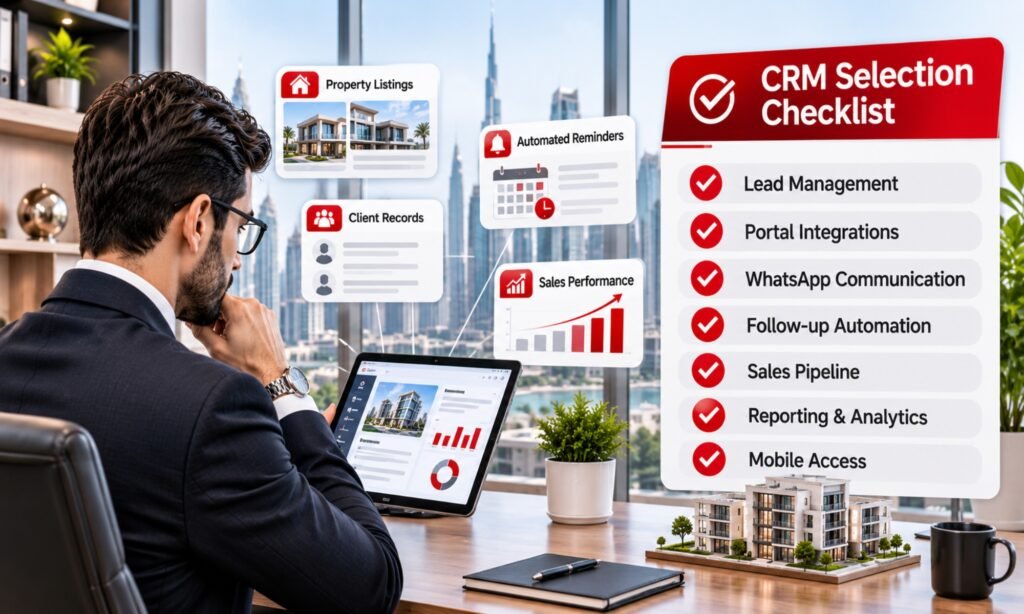
Before choosing a CRM provider, review the following requirements with your management and sales teams.
Lead management
- Can the system capture enquiries from our main marketing channels?
- Can new leads be assigned automatically?
- Can agents track enquiry status and communication history?
- Are follow-up reminders available?
Property management
- Can we organize property listings and availability?
- Does the platform support off-plan and secondary-market properties?
- Can agents match customer requirements with suitable listings?
Integrations
- Does it support the required Bayut integration?
- Can it connect with Property Finder?
- Is Dubizzle integration available?
- Does it support WhatsApp Business?
- Can it connect with our existing website and business tools?
Team management
- Can managers monitor agent activities?
- Are role-based permissions available?
- Can we create customized sales pipelines?
- Are performance reports available?
Security and implementation
- How is customer data protected?
- Are backups and access controls provided?
- Is employee training included?
- What implementation support is available?
Pricing and support
- Are setup and integration charges clearly explained?
- What is included in the subscription or license?
- Can the platform support future business growth?
- Is technical assistance available when required?
Completing this checklist before signing an agreement can help your agency avoid choosing a platform that looks suitable in a presentation but does not support its actual operations.
Conclusion
Selecting CRM software for real estate agents in Dubai requires a clear understanding of how your business manages enquiries, clients, properties and sales activities.
A useful platform should bring customer information into one place, support the team’s follow-up process, connect with relevant property portals and provide visibility into sales operations. Its mobile access, security arrangements, pricing and implementation support also deserve careful consideration.
There is no single CRM configuration that works for every property business. Independent agents, established brokerages and property developers have different requirements, so the right choice should reflect the way each organization operates.
Take time to compare the available systems, request practical demonstrations and involve the employees who will use the software every day. A well-selected CRM can provide a more organized foundation for managing property enquiries and maintaining client relationships as your business grows.
Frequently Asked Questions About Real Estate CRM Software
1. What is CRM software for real estate agents?
CRM software for real estate agents is a system used to organize client information, property enquiries, communication records and sales opportunities. It helps agents manage prospects, schedule follow-ups, track property requirements and monitor transactions through a centralized platform.
2. How do I choose CRM software for a real estate agency in Dubai?
Start by identifying your agency’s lead sources, number of agents, property categories and communication requirements. Compare platforms based on lead capture, agent assignment, Bayut and Property Finder integrations, WhatsApp functionality, reporting, security, pricing and technical support. Request a demonstration before selecting a provider.
3. What features should a real estate CRM include?
A real estate CRM should ideally provide lead capture, contact management, automated follow-ups, lead assignment, property listing management, sales pipeline tracking, communication integrations and reporting. Mobile accessibility and appropriate user permissions are also important for agencies managing multiple agents.
4. Can real estate CRM software integrate with Bayut and Property Finder?
Yes. Some real estate CRM platforms support integrations with Bayut and Property Finder through available APIs and approved connections. The actual functionality depends on the provider, portal permissions and integration configuration. Agencies should verify how enquiries are captured, synchronized and assigned.
5. Can CRM software automate WhatsApp follow-ups?
Some CRM platforms support WhatsApp Business integration, message templates, notifications and automated follow-up workflows. The available functions depend on the integration. Businesses should also follow applicable WhatsApp messaging policies and obtain the required customer consent.
6. How much does real estate CRM software cost in Dubai?
The cost depends on the number of users, features, integrations, customization, hosting and support requirements. Providers may offer monthly subscriptions, annual licenses or one-time payment arrangements. Request an itemized quotation to understand setup fees, recurring charges and additional integration costs.
7. Is cloud-based CRM suitable for Dubai real estate agencies?
Cloud-based CRM software can be suitable for agencies that need access to customer information and sales activities from different locations. Before choosing a provider, review its hosting arrangements, data protection measures, backup procedures, authentication and user access controls.
8. Can a real estate CRM manage multiple agents?
Yes. Many dedicated CRM platforms support multiple users, agent assignment, team dashboards and activity reporting. Managers can use these functions to distribute enquiries, review follow-up activities and monitor opportunities across different teams.
9. What is the difference between real estate CRM and property management software?
Real estate CRM primarily manages customer relationships, enquiries, communication and sales opportunities. Property management software focuses on activities such as tenant records, leases, maintenance and rental payments. Some platforms combine both functions, but businesses should verify the available modules.
10. Is dedicated real estate CRM software better than Excel?
Excel can be sufficient for basic contact records and small workloads. However, it does not provide the same built-in lead distribution, communication integrations, automated reminders and sales pipeline visibility as a dedicated CRM. Agencies handling growing enquiry volumes may benefit from a centralized CRM platform.