
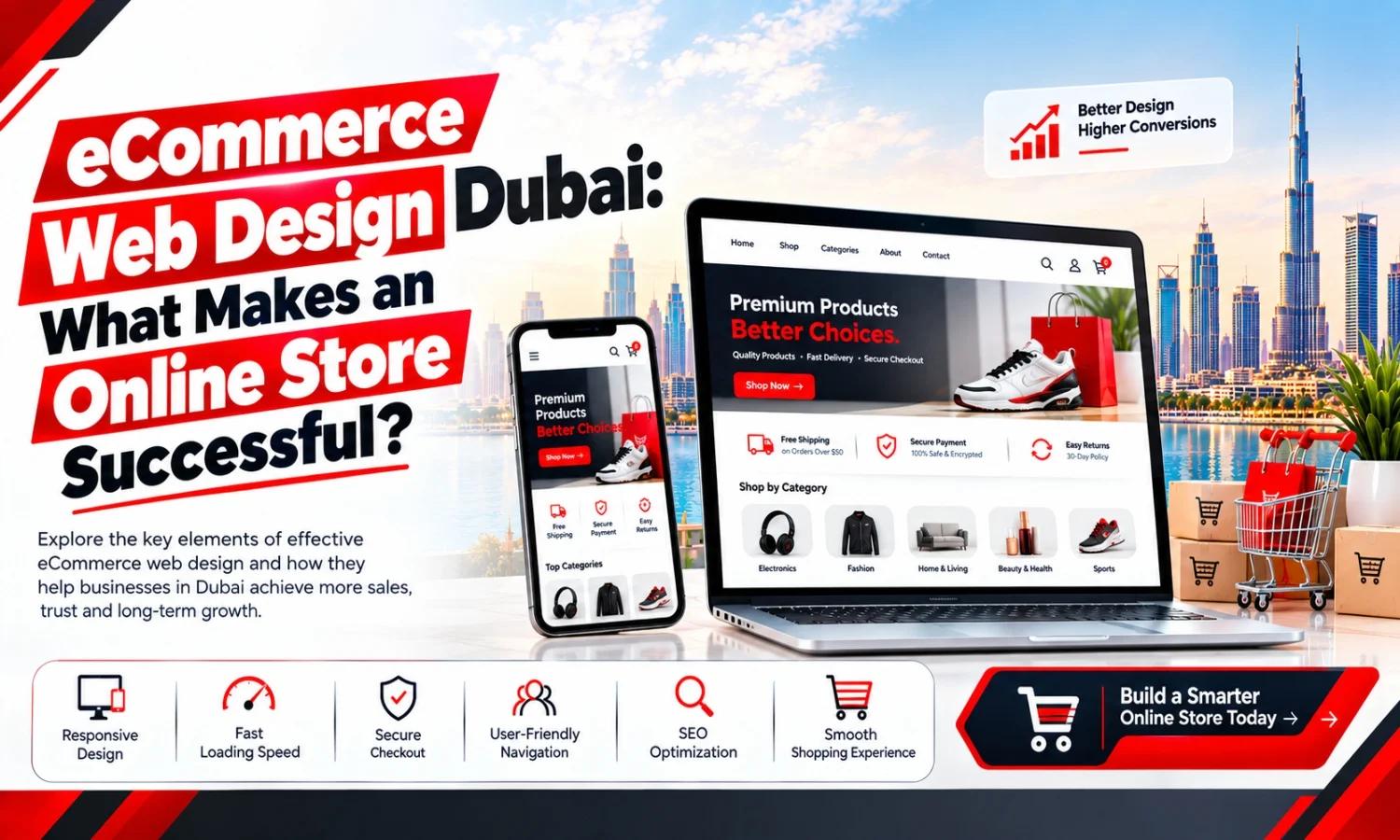
A successful online store needs more than attractive visuals. ecommerce web design Dubai should make it easy for shoppers to find products, understand their options, trust the business and complete a purchase without unnecessary friction.
For businesses in Dubai, an ecommerce website also needs to work well across mobile devices, support a smooth customer journey and communicate clearly with a local and international audience. Design, usability, performance, product presentation, checkout experience and search visibility all play a role.
A well-designed ecommerce website should therefore be built around the customer first. The goal is not simply to create a website that looks modern. The goal is to create an online shopping experience that is clear, convenient and capable of supporting business growth.
What Makes an Ecommerce Website Successful?
A successful ecommerce website brings together several important elements:
- Clear and attractive product presentation
- Simple website navigation
- Strong ecommerce UX
- Fast loading performance
- Mobile-friendly design
- Easy product discovery
- Secure and straightforward checkout
- Useful product information
- Visible trust signals
- Clear calls to action
- Search-friendly website structure
- Helpful customer support options
- Flexible payment and delivery information
- Continuous testing and improvement
None of these elements work in isolation. A beautiful website with difficult navigation can lose customers. A fast website with poor product information can create uncertainty. A website with excellent products but a complicated checkout can lose sales at the final stage.
Good ecommerce web design connects these pieces into one consistent customer journey.
1. Start With a Clear Ecommerce Customer Journey
Before thinking about colors, animations or visual effects, an online store needs a clear structure.
A typical ecommerce journey might look like this:
Homepage → Category → Product → Cart → Checkout → Confirmation
Customers should be able to move through these stages without confusion.
For example, a visitor arriving at an online fashion store should quickly understand what the business sells. From there, they should be able to browse categories, filter products, compare relevant information, select a product and move toward checkout.
This is one reason ecommerce website design Dubai should be based on user behavior rather than visual trends alone.
The navigation should answer simple questions:
- Where am I?
- What products are available?
- How can I find the product I need?
- What does this product cost?
- When can I receive it?
- How can I return it?
- How do I contact the business?
When these questions are easy to answer, the shopping experience becomes much more comfortable.
2. Make Product Discovery Simple
A customer should not have to work hard to find a product.
A good ecommerce website can organize products through:
- Clear categories
- Subcategories
- Search functionality
- Filters
- Sorting options
- Product recommendations
- Related products
- Useful product attributes
For larger stores, navigation becomes even more important because customers may enter through search engines, product pages, category pages or direct links instead of starting from the homepage.
Google’s ecommerce guidance recommends creating a crawlable structure in which important category, subcategory and product pages can be reached through links. Google also notes that internal linking helps it understand the relative importance and relationship between pages.
That means good navigation benefits both shoppers and search visibility.
3. Use Product Pages That Answer Customer Questions
The product page is one of the most important parts of an ecommerce website.
A customer should not need to search elsewhere to understand what they are buying.
Depending on the product, a strong product page may include:
- Product name
- High-quality images
- Product description
- Key specifications
- Available variations
- Price
- Availability
- Delivery information
- Return information
- Reviews
- Frequently asked questions
- Clear purchase button
- Related products
Product photography should show the item clearly. If there are important details, include additional images rather than relying on one photograph.
Product descriptions should also focus on customer needs. Instead of listing technical information without context, explain what the product does, who it is for and why its features matter.
4. Build Ecommerce UX Around Real Shoppers
Ecommerce UX refers to the experience people have while interacting with an online store.
Good UX removes unnecessary effort.
For example, a customer should not have to:
- Click through several irrelevant pages to reach a product
- Create an account before understanding delivery costs
- Search through unclear menus
- Complete a long and confusing form
- Guess whether a product is available
- Search extensively for return information
A better experience provides the information customers need at the moment they need it.
This is particularly important on mobile devices, where limited screen space makes unnecessary steps even more frustrating.
5. Make Mobile Ecommerce a Priority
Many customers browse and shop using smartphones. A successful ecommerce website therefore needs to work comfortably on smaller screens.
Responsive ecommerce web design should provide:
- Easy-to-read text
- Touch-friendly buttons
- Simple navigation
- Properly sized product images
- Easy product filtering
- Accessible search
- Comfortable forms
- A checkout process designed for mobile use
Mobile design should not be treated as a smaller version of the desktop website.
The experience should be considered from the beginning.
A customer using a phone should be able to browse products, view important details, select variations and continue toward checkout without constantly zooming or repositioning the screen.
6. Improve Website Speed and Performance
Performance affects the shopping experience.
Large images, unnecessary scripts, poorly optimized pages and inefficient website architecture can make an online store slower.
A practical ecommerce website should focus on:
- Optimized images
- Efficient code
- Appropriate image dimensions
- Fast hosting
- Reduced unnecessary scripts
- Efficient page loading
- Mobile performance
- Stable layouts
Speed should not be pursued by removing useful information or functionality. The goal is to create a balanced experience where the website remains useful while loading efficiently.
A fast store also makes it easier for customers to browse multiple products without feeling that every click requires a long wait.
7. Use Clear Calls to Action
A shopper should understand what to do next.
Depending on the page, the primary action might be:
- Shop now
- View product
- Add to cart
- Buy now
- Request information
- Compare products
- Contact the business
Calls to action should be noticeable without becoming aggressive.
For example, a product page should make the purchasing action easy to identify. A category page might encourage users to explore a product range.
The wording should also match the customer’s stage in the buying journey.
8. Build Trust Before Asking for the Sale
People are more likely to purchase when they feel confident about the business and the product.
Useful ecommerce website trust signals can include:
- Customer reviews
- Product ratings
- Business information
- Contact details
- Delivery information
- Return policy
- Secure payment information
- Frequently asked questions
- Clear warranty information where relevant
- Authentic product photography
- Customer support options
For a Dubai ecommerce business, displaying clear business information can also help customers understand who they are purchasing from and how they can get support.
Trust should be built throughout the website, not placed on one isolated page.
9. Make Checkout Simple
A customer who reaches checkout has already shown strong purchase intent.
This makes checkout usability particularly important.
A good checkout experience should avoid unnecessary friction.
Consider:
- Short forms
- Clear order summaries
- Transparent costs
- Delivery information
- Appropriate payment choices
- Easy editing of cart items
- Clear error messages
- Mobile-friendly fields
- Confirmation after purchase
Unexpected costs appearing at the final stage can create hesitation. Customers should have a clear understanding of the total order cost and relevant delivery information before completing payment.
10. Give Customers Useful Search and Filtering
Search becomes increasingly important as an ecommerce store grows.
A store with 20 products may be easy to browse manually. A store with thousands of products needs better discovery tools.
Useful filters can include:
- Price
- Category
- Size
- Color
- Brand
- Material
- Availability
- Product type
- Relevant technical specifications
Filters should reflect the way customers actually compare products.
For example, a customer shopping for electronics may care about storage, screen size and connectivity. Someone shopping for clothing may care about size, color and material.
Good ecommerce web design starts with understanding these differences.
11. Make Delivery and Returns Easy to Understand
Customers want to know what happens after they place an order.
Important information can include:
- Delivery areas
- Estimated delivery time
- Delivery charges
- Same-day or express options where available
- Return period
- Exchange policy
- Refund process
- Damaged product procedure
This information should be easy to find.
Hiding important policies creates uncertainty. Clear information helps customers make informed purchasing decisions.
For businesses serving Dubai and the wider UAE, delivery information can be especially important because customers may have different expectations depending on location and delivery method.
12. Design for Search Visibility From the Beginning
Ecommerce SEO should not be added after the website is finished.
Search-friendly ecommerce website development considers:
- Logical site architecture
- Crawlable navigation
- Descriptive page titles
- Useful product descriptions
- Descriptive URLs
- Internal links
- Image optimization
- Appropriate structured data
- Indexable product and category pages
- Canonicalization where necessary
Google’s ecommerce documentation specifically recommends making ecommerce content accessible through appropriate site structures and links so search engines can discover important pages.
Product structured data can also help Google understand information such as product details, prices, availability and reviews when the markup is implemented correctly.
This does not guarantee rankings or rich results. Structured data helps search engines understand eligible content, but Google decides when and whether enhanced search appearances are shown.
13. Use High-Quality Product Images
Images are central to online shopping because customers cannot physically inspect products before purchasing.
A strong ecommerce website should use:
- Clear product photography
- Multiple useful angles
- Appropriate image sizes
- Descriptive filenames where practical
- Useful alt text
- Consistent presentation
Images should load efficiently without sacrificing the information shoppers need.
For some businesses, additional visual content such as product demonstrations, videos or comparison images can help customers understand the product more confidently.
14. Consider Arabic and English Ecommerce Experiences
Dubai has a highly diverse customer base.
Depending on the target market, an ecommerce business may benefit from supporting both English and Arabic experiences.
A bilingual ecommerce website needs more than simply translating visible words. Navigation, product descriptions, forms, buttons, customer support information and layouts should all work naturally in each language.
Arabic also requires consideration of right-to-left presentation.
The objective should be a consistent shopping experience rather than a website where one language feels like an afterthought.
15. Connect Design With Conversion Goals
A successful online store should have measurable business objectives.
These might include:
- Product purchases
- Enquiries
- Account registrations
- Quote requests
- Repeat purchases
- Newsletter subscriptions
- Product interactions
The design should support these goals.
For example, if the main objective is online sales, product discovery and checkout should receive significant attention. If customers typically need assistance before purchasing, product pages should make contact and support options easy to access.
This is where conversion-focused ecommerce website Dubai strategies become useful. The design should connect customer needs with measurable business outcomes.
What Ecommerce Website Features Should a Successful Store Have?
A practical ecommerce website features checklist includes:
| Feature | Why it matters |
| Responsive design | Makes the store usable across devices |
| Product search | Helps shoppers find products quickly |
| Filters | Makes large product catalogs easier to browse |
| Clear categories | Improves navigation |
| Detailed product pages | Helps customers make decisions |
| Reviews | Provides social proof |
| Clear CTAs | Guides users toward the next action |
| Simple checkout | Reduces unnecessary friction |
| Delivery information | Sets customer expectations |
| Return information | Builds confidence |
| Secure experience | Supports customer trust |
| Fast performance | Improves usability |
| Internal linking | Connects important ecommerce pages |
| Structured data | Helps search engines understand eligible content |
| Analytics | Helps measure customer behavior |
How Much Does Ecommerce Web Design Cost in Dubai?
The ecommerce web design Dubai price can vary significantly depending on the size and requirements of the project.
A simple online store with a limited catalog generally requires less planning and development than a larger ecommerce operation with hundreds or thousands of products, advanced filtering, custom functionality, multiple languages, integrations and complex business rules.
The final cost can depend on:
- Number of products
- Custom design requirements
- Website functionality
- Payment integration
- Delivery integration
- Product variations
- Multilingual requirements
- Customer account features
- Third-party integrations
- Custom ecommerce development
- SEO requirements
- Ongoing maintenance
Instead of choosing a provider based only on the lowest quote, businesses should compare what is actually included in the project.
A low initial price may not represent the complete cost if important features, integrations or ongoing support are excluded.
How to Choose an Ecommerce Web Design Company in Dubai
When comparing ecommerce web design companies in Dubai, look beyond screenshots.
Review:
- Previous ecommerce projects
- Experience with businesses similar to yours
- Product and category page design
- Mobile experience
- Ecommerce UX approach
- SEO knowledge
- Performance considerations
- Integration capabilities
- Post-launch support
- Ownership and access to website assets
Ask potential providers how they approach product discovery, checkout, mobile usability, SEO and ongoing improvements.
The right questions can reveal more than a polished portfolio alone.
Why Choose A-One Web Design Dubai for Ecommerce Web Design?
A-One Web Design Dubai provides website design and development services for businesses that need professional digital experiences in Dubai, UAE.
For an ecommerce project, the focus should be on creating a website that combines visual presentation with usability, product discovery, mobile responsiveness, performance and conversion-focused design.
The exact approach should depend on the business model, products, target customers and operational requirements.
For businesses considering ecommerce web design in Dubai, a clear project brief should define the required features, customer journey, integrations, content requirements and business goals before development begins.
Frequently Asked Questions
What makes an ecommerce website successful?
A successful ecommerce website makes it easy for customers to discover products, understand product information, trust the business and complete purchases. Mobile usability, performance, navigation, product pages and checkout all contribute to the overall experience.
What should an ecommerce website include?
Important ecommerce website features can include product search, category navigation, filters, detailed product pages, product images, reviews, clear calls to action, cart functionality, checkout, delivery information, return policies and customer support.
How important is ecommerce UX?
Ecommerce UX is important because it affects how easily customers can browse products, compare options and complete purchases. A confusing experience can create unnecessary friction during the buying journey.
Is mobile design important for an ecommerce website?
Yes. Ecommerce websites should provide a comfortable experience across smartphones, tablets and desktops. Mobile navigation, product browsing, forms and checkout should all be considered during the design process.
How much does ecommerce web design cost in Dubai?
Ecommerce web design costs vary according to the website’s functionality, number of products, design requirements, integrations, languages, custom development and support requirements. Businesses should compare complete project scopes rather than price alone.
How can I improve my ecommerce website conversion rate?
Start by reviewing product pages, navigation, mobile usability, page speed, calls to action, checkout friction, trust signals and customer behavior data. Improvements should be tested and measured rather than based only on assumptions.
Is SEO important for ecommerce website design?
Yes. Ecommerce SEO should be considered during website architecture and development. Crawlable navigation, useful content, internal links, appropriate structured data and accessible product pages can help search engines understand the website.
Can an ecommerce website support Arabic and English?
Yes. A bilingual ecommerce website can serve both English and Arabic audiences. The design should account for translation quality, navigation, content structure and right-to-left presentation where appropriate.
What is the difference between ecommerce web design and ecommerce web development?
Ecommerce web design focuses heavily on the visual interface, user experience, layout and customer journey. Ecommerce web development involves implementing the functionality behind that experience, including product management, cart, checkout, integrations and other technical requirements. In a successful project, both areas work together.
How do I choose an ecommerce web designer in Dubai?
Review their ecommerce portfolio, mobile designs, UX approach, development capabilities, SEO knowledge, support process and experience with similar businesses. Ask what is included in the project before making a decision.
Final Thoughts
A successful online store is not defined by its appearance alone.
Strong ecommerce web design Dubai combines useful product presentation, intuitive navigation, mobile usability, fast performance, trustworthy information and a simple purchasing journey.
The best approach is to start with the customer. Understand what shoppers need to know, how they search for products, what concerns they may have and what could prevent them from completing a purchase.
From there, design the website around those needs.
For Dubai businesses, the opportunity is even broader because an ecommerce website can serve local customers while also supporting sales across the UAE and international markets.
If the website is easy to use, easy to understand and technically accessible to search engines, it has a stronger foundation for long-term growth.
Google’s current guidance also reinforces this principle: create useful, reliable, people-first content and make ecommerce pages accessible through a logical structure. Google also states that its normal SEO best practices remain relevant to AI search experiences, with no separate optimization requirement for AI Overviews or AI Mode.
The goal should therefore be simple: build an ecommerce website that works for real customers first, then make it easy for search engines to understand.


