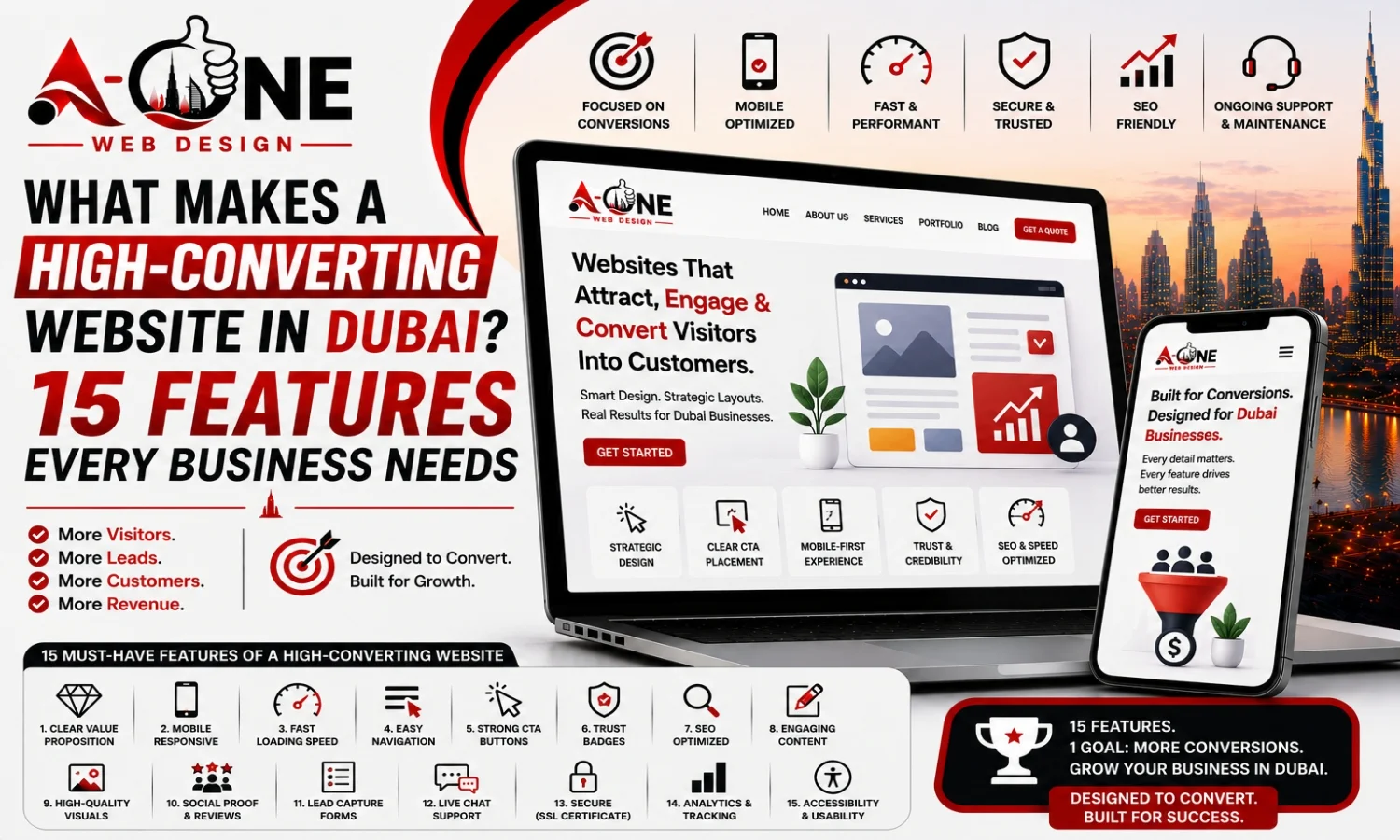
A high converting website Dubai businesses can rely on does more than look professional. It guides visitors toward useful actions such as making an enquiry, requesting a quote, booking a service or completing a purchase.
Getting people to visit your website is only half the job.
The bigger question is what happens after they arrive.
Do they understand what your business offers? Can they find the information they’re looking for? Do they trust your company? Can they contact you quickly? And is there a clear reason for them to take the next step?
A high converting website in Dubai is designed around those questions.
It isn’t simply a website with attractive colours, animations and modern graphics. A conversion-focused website combines clear messaging, good user experience, strong calls to action, trust signals, fast performance and an easy path to contact or purchase.
For a Dubai business, this can mean turning more website visitors into enquiries, calls, bookings, quotation requests or customers.
In this guide, we’ll look at 15 features that can help make a business website more effective at converting visitors.
What Makes a High Converting Website Dubai Businesses Need?
A high-converting website is a website designed to encourage visitors to take a valuable action.
That action depends on the business.
It could be:
- Calling the company
- Sending a WhatsApp message
- Completing a contact form
- Requesting a quotation
- Booking an appointment
- Purchasing a product
- Registering for an account
- Downloading a resource
- Visiting a physical location
Conversion doesn’t always mean making an immediate sale.
For a B2B company, submitting an enquiry may be the main conversion.
For a restaurant, it might be a reservation.
For an ecommerce store, it’s a complete purchase.
For a property company, it could be a viewing request.
So the first step in conversion focused web design in Dubai is defining what success actually means for the business.
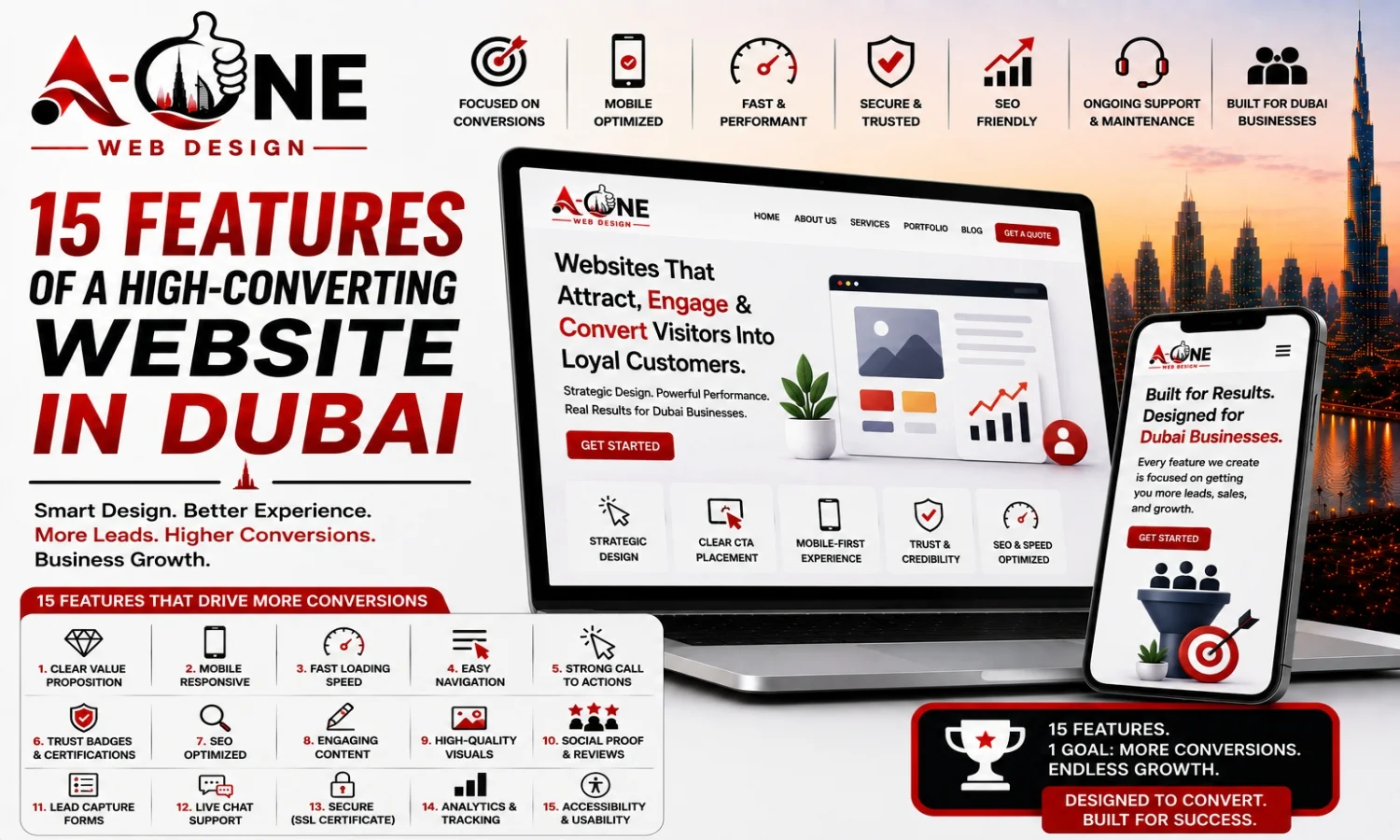
15 Features of a High-Converting Website in Dubai
1. A Clear Value Proposition
Visitors should understand what your business does almost immediately.
Your homepage shouldn’t make people work to figure out:
- What you offer
- Who you serve
- Where you operate
- Why they should choose you
- What they should do next
A strong value proposition answers these questions quickly.
For example, instead of a vague headline such as:
“Welcome to Our Website”
a service business could use something more specific:
“Professional AC Maintenance for Homes and Businesses Across Dubai”
The second statement immediately communicates the service, audience and location.
Your headline doesn’t need to be clever.
It needs to be clear.
2. Strong Calls to Action
A visitor may be interested in your service but still leave if they don’t know what to do next.
That’s where calls to action come in.
Common CTAs include:
- Get a Quote
- Request a Consultation
- Book an Appointment
- Call Now
- WhatsApp Us
- Shop Now
- Get Started
- Contact Our Team
Your primary CTA should be easy to notice without overwhelming the visitor.
A conversion-focused website in Dubai should guide visitors naturally toward the next step.
3. Mobile-First Responsive Design
A website needs to work properly on smartphones, tablets and desktops.
Mobile users shouldn’t have to:
- Zoom in to read text
- Struggle with tiny buttons
- Scroll sideways
- Fight with complicated menus
- Wait for oversized images
- Fill out awkward forms
Responsive design adapts the website to different screen sizes.
But mobile optimisation is more than shrinking a desktop page.
The mobile experience should be planned intentionally.
Menus, buttons, forms, images, content sections and CTAs all need to work comfortably on smaller screens.
4. Fast Page Speed
People don’t like waiting for websites to load.
Slow pages can create a poor user experience, particularly when visitors are browsing on mobile connections.
Performance can also affect how search engines assess the experience of a page.
A professional website should pay attention to:
- Image sizes
- Browser caching
- Code efficiency
- Hosting performance
- Unnecessary scripts
- Font loading
- Third-party tools
- Page structure
Tools such as Google’s PageSpeed Insights can help identify performance problems.
Speed isn’t about making a website load quickly simply for a score.
It’s about making it easier for real people to access and use the website.
5. Simple Website Navigation
A visitor shouldn’t need to hunt for basic information.
Your navigation should make important sections easy to find.
Depending on the business, that might include:
Home | About | Services | Projects | Blog | Contact
An ecommerce website may need:
Home | Shop | Categories | About | Support | Contact
Don’t add navigation items simply because you have the pages.
Prioritise the pages that matter most to customers.
A clean structure reduces friction and helps visitors reach the information they need.
6. Trust Signals
People don’t buy from businesses they don’t trust.
A website should give visitors reasons to feel confident.
Useful trust signals can include:
- Customer reviews
- Testimonials
- Case studies
- Client logos
- Certifications
- Awards
- Years of experience
- Project results
- Business address
- Phone number
- Professional email
- Secure payment information
- Clear company information
The right trust signals depend on the industry.
A B2B consultancy may benefit from case studies and client logos.
An ecommerce store may benefit from product reviews, secure payment information and clear returns policies.
A local Dubai business may benefit from a visible address, phone number and genuine customer reviews.
7. Real Customer Reviews and Testimonials
Reviews can reduce uncertainty.
A potential customer may wonder:
“Has anyone else used this company?”
Testimonials help answer that question.
Where appropriate, include:
- Customer name
- Company name
- Relevant service
- Specific result or experience
- Genuine review
Avoid vague testimonials such as:
“Great company. Highly recommended.”
A more useful testimonial explains what the customer actually valued.
For example, a client might mention communication, delivery time, service quality or a specific result.
Authenticity matters more than having dozens of generic quotes.
8. Clear and Persuasive Website Copy
Design gets attention.
Words explain the offer.
Your website copy should focus on the customer’s needs rather than simply describing the company.
Instead of writing:
“We are a leading company providing innovative solutions.”
explain:
- What problem do you solve?
- Who do you solve it for?
- What does the customer get?
- Why should they choose you?
- What happens after they contact you?
Use short paragraphs, descriptive headings and straightforward language.
A visitor should be able to scan the page and understand the main points without reading every word.
9. Dedicated Service or Product Pages
Don’t put every service on one crowded page.
If your business provides several services, give important services their own pages.
For example:
Home
→ Web Design
→ Web Development
→ Ecommerce Development
→ SEO
→ Website Maintenance
Each page can then explain:
- What the service includes
- Who it’s for
- Benefits
- Process
- Relevant examples
- FAQs
- Pricing information where appropriate
- CTA
This helps users find relevant information and also gives search engines clearer context about your website.
10. Easy Contact Options
Don’t make customers work to contact you.
A professional business website design in Dubai should make contact information easy to find.
Depending on your business, consider:
- Phone number
- Contact form
- Booking system
- Physical address
- Google Maps
- Social media
For local service businesses, click-to-call and WhatsApp can be particularly useful.
However, don’t fill every screen with pop-ups and buttons.
The goal is accessibility, not pressure.
11. Short, User-Friendly Contact Forms
Long forms can create unnecessary friction.
If you only need:
- Name
- Phone
- Service
- Message
don’t ask for 15 additional fields.
For more complex businesses, additional information may be useful.
The principle is simple:
Only ask for information you actually need at that stage.
The CTA should also tell the visitor what happens next.
For example:
Request a Free Consultation
can be more informative than:
Submit
12. Strong Landing Pages
Landing pages are useful when you want visitors to take one specific action.
A landing page might promote:
- A service
- An offer
- A consultation
- A product
- An event
- A downloadable resource
- A paid advertising campaign
A focused landing page normally removes unnecessary distractions and gives the visitor a clear path toward the desired action.
For example, if you’re running Google Ads for a specific service, sending visitors to a dedicated service landing page may provide a more relevant experience than sending everyone to the homepage.
13. Website Security and Professional Presentation
Trust can disappear quickly when a website looks unsafe or poorly maintained.
A professional website should use HTTPS and keep its software and components updated.
Also check basic details such as:
- Working links
- Correct contact information
- No broken images
- No outdated offers
- No placeholder text
- No unnecessary pop-ups
- No obvious spelling mistakes
These details may seem small, but they influence how visitors perceive the business.
14. Analytics and Conversion Tracking
You can’t improve what you don’t measure.
A business website should have appropriate analytics and conversion tracking.
Depending on the website, you may want to measure:
- Contact form submissions
- Phone clicks
- WhatsApp clicks
- Quote requests
- Bookings
- Purchases
- Newsletter signups
- Landing page performance
Analytics can help answer questions such as:
Which pages attract visitors?
Where do people leave?
Which traffic sources generate enquiries?
Which pages produce the most conversions?
This information turns website optimisation from guesswork into a process based on actual user behaviour.
15. Continuous Conversion Optimisation
Launching a website doesn’t mean the work is finished.
A website can often be improved after launch by reviewing real data and testing changes.
For example, you might test:
- Headline wording
- CTA placement
- Button text
- Form length
- Page layout
- Testimonials
- Pricing presentation
- Images
- Landing page structure
This is where website conversion optimization in Dubai becomes an ongoing activity rather than a one-time design task.
You don’t need to change everything at once.
Start with the pages that receive meaningful traffic and have the greatest business value.
What Makes a Website Convert Visitors Into Customers?
There isn’t one magic feature.
Conversions usually come from several elements working together.
Think about the visitor’s journey:
Search or advertisement
↓
Landing on the website
↓
Understanding the offer
↓
Building trust
↓
Finding the right information
↓
Seeing the next step
↓
Taking action
A problem at any stage can reduce the chance of conversion.
For example, a business might have excellent services and a beautiful website, but if the contact button is difficult to find, some visitors may leave without enquiring.
Another business might have a very visible CTA, but weak messaging and no trust signals.
The best results come when the entire experience makes sense.
Conversion-Focused Website Design vs a Normal Website
A normal website may primarily communicate information.
A conversion-focused website asks a second question:
“What should the visitor do next?”
That doesn’t mean every page should aggressively sell.
It means every important page should have a purpose.
For example:
Homepage
Goal: Explain the business and direct visitors to key services.
Service page
Goal: Explain the service and generate enquiries.
Case study
Goal: Build confidence through evidence.
About page
Goal: Build trust and credibility.
Contact page
Goal: Make contacting the business easy.
Product page
Goal: Explain the product and encourage purchase.
This approach makes the website more intentional.
How Dubai Businesses Can Improve Website Conversions
The same conversion principles apply globally, but local context matters.
A Dubai business may serve customers from different countries, languages and backgrounds.
Depending on the audience, consider:
Arabic and English Content
If your customers speak both languages, a bilingual website may improve accessibility.
Arabic content also needs proper RTL support rather than simply being pasted into an English layout.
Local Contact Information
Make your Dubai location and contact details clear when they’re relevant to the customer.
For businesses where customers commonly prefer messaging, WhatsApp can provide a direct contact option.
Local Trust
Relevant local reviews, project examples, business information and customer experiences can help establish credibility.
Currency and Payment Options
For ecommerce websites, customers should understand prices, payment methods, shipping and returns before reaching checkout.
Common Website Conversion Mistakes
Even attractive websites can lose potential customers.
Watch out for these problems.
Too Many CTAs
If every button says something different, visitors may not know which action matters.
Weak Headlines
A vague headline makes visitors work too hard to understand the offer.
Long Forms
Every unnecessary field creates another opportunity for someone to abandon the form.
Poor Mobile Experience
A website that works only on desktop isn’t enough.
Hidden Contact Information
If someone wants to call you, make it easy.
Stock-Heavy Design
Generic imagery can make a business look less distinctive.
No Social Proof
Visitors may hesitate when there is no evidence that other customers trust the business.
Slow Pages
Performance problems can frustrate visitors before they even see your offer.
Too Much Text
Important information gets lost when every page becomes a wall of paragraphs.
No Measurement
Without analytics and conversion tracking, you won’t know what’s working.
How to Measure Website Conversion Rate
A simple conversion rate formula is:
Conversion Rate = Conversions ÷ Visitors × 100
For example, if 1,000 relevant visitors arrive at your website and 40 complete your chosen conversion action:
40 ÷ 1,000 × 100 = 4%
But don’t assume that one conversion rate is automatically “good” or “bad.”
Conversion rates vary significantly by:
- Industry
- Traffic source
- Device
- Location
- Offer
- Price
- Audience
- Purchase cycle
- Conversion type
A B2B company may have fewer conversions because customers need more time to make a decision.
An ecommerce store may have a completely different benchmark.
Focus on your own data and improve it over time.
How SEO and Conversion Rate Work Together
SEO brings relevant visitors to your website.
Conversion-focused design helps those visitors take action.
You need both.
Imagine a website receives thousands of visitors but very few enquiries.
Traffic alone isn’t enough.
Now imagine a beautiful website converts well but receives almost no relevant traffic.
That isn’t enough either.
A strong website strategy connects:
Search visibility + relevant traffic + useful content + good UX + clear conversion paths
This is why SEO and conversion-focused web design in Dubai should work together rather than being treated as completely separate activities.
Is a High-Converting Website the Same as a Beautiful Website?
No.
Visual quality matters, but appearance alone doesn’t create conversions.
A beautiful website can still fail if:
- The message is unclear.
- Navigation is confusing.
- Pages load slowly.
- The CTA is hidden.
- The offer isn’t convincing.
- The website isn’t mobile-friendly.
- Customers don’t trust the business.
The strongest websites balance visual design with usability and business goals.
What Should a Professional Website Include?
At minimum, most professional business websites should consider:
- Clear value proposition
- Responsive design
- Simple navigation
- Strong service or product pages
- Clear CTAs
- Contact options
- Trust signals
- Fast performance
- Security
- Basic SEO foundations
- Analytics
- Conversion tracking
The exact requirements depend on the business.
An ecommerce store needs features that a consulting company doesn’t.
A restaurant needs different functionality from a property developer.
That’s why website features should always be selected around the customer journey.
Final Thoughts
A high converting website in Dubai isn’t created by adding more buttons, more animations or more content.
It starts with understanding the customer.
What are they looking for?
What questions do they have?
What might stop them from contacting you?
What information do they need before making a decision?
And what is the easiest next step you can give them?
The 15 features covered in this guide, from clear messaging and mobile design to trust signals, landing pages, analytics and conversion tracking, all support the same goal:
Make it easier for the right visitor to become a customer.
For Dubai businesses, that means building a website that isn’t just present online, but actually supports enquiries, bookings, sales and long-term growth.
Frequently Asked Questions
What is a high-converting website?
A high-converting website is designed to encourage visitors to complete a valuable action, such as submitting an enquiry, calling a business, booking an appointment or purchasing a product.
What makes a website high converting?
Clear messaging, strong calls to action, mobile-friendly design, fast performance, simple navigation, trust signals, useful content, easy contact options and conversion tracking all contribute to a better conversion-focused website.
How can I increase my website conversion rate in Dubai?
Start by checking your most important pages. Improve the headline, clarify the offer, strengthen CTAs, simplify forms, add relevant trust signals, improve mobile usability and measure conversions through analytics.
What is conversion-focused web design?
Conversion-focused web design combines visual design, user experience, content and functionality around specific business goals. The objective is to help visitors take the next useful action.
Is mobile-friendly design important for website conversions?
Yes. Visitors should be able to read content, navigate pages, use forms and click CTAs comfortably on smartphones and other devices.
Should every website have WhatsApp?
Not necessarily. WhatsApp can be useful for businesses whose customers prefer messaging, but the right contact method depends on the audience and business model.
How many calls to action should a website have?
There isn’t a universal number. Important pages should have a clear primary action, while secondary actions can be provided where useful. Too many competing CTAs can make the page confusing.
Does website speed affect conversions?
Website speed affects user experience, and slow pages can create frustration. Improving performance can make a website easier to use, particularly on mobile devices.
What is the difference between SEO and conversion optimization?
SEO focuses on helping relevant users discover your website through search. Conversion optimization focuses on helping those visitors take a desired action. Strong websites consider both.
How do I know if my website is converting?
Set up conversion tracking for meaningful actions such as forms, calls, WhatsApp clicks, bookings or purchases. Then compare conversions with relevant website traffic.
Can a redesign increase website conversions?
It can, particularly when the existing website has usability, messaging, mobile, performance or trust problems. However, results depend on the specific business, audience, traffic and offer.
Should I use testimonials on my website?
Relevant, genuine testimonials can help reduce uncertainty and build trust. Use specific customer experiences where possible rather than generic statements.
Does a high-converting website need custom web design?
Not always. A well-planned website using an established platform can convert effectively. Custom design becomes useful when a business has specific branding, UX or functionality requirements.
How often should I optimise my website for conversions?
Conversion optimisation should be treated as an ongoing process. Review performance regularly and prioritise changes based on actual user behaviour and business results.


